Specifying filtration systems requires a precise balance between maximum throughput and absolute particle retention. Engineers must design systems capable of handling massive fluid volumes while blocking microscopic contaminants. This fundamental engineering challenge defines every industrial process upgrade. Slot size is never just a static dimension printed on a specification sheet. It acts as a highly dynamic variable. It dictates system longevity, maintenance intervals, and operational pressure. Poorly sized apertures inevitably lead to catastrophic equipment failure or unacceptable pressure drops across the pipeline.
Our objective here is entirely practical. We aim to provide technical decision-makers a robust, evidence-based framework for evaluating filtration media. You will learn how to assess exact slot sizes accurately. We also explore calculating open area requirements mathematically to prevent bottlenecks. Finally, we guide you on avoiding common specification failures leading to premature system degradation. Understanding these core mechanics ensures you design a resilient, highly efficient filtration architecture.
Key Takeaways
Precision dictates performance: Slot width directly impacts pressure drop (head loss) and energy consumption in the pumping system.
Profile matters as much as size: Continuous V-shaped slots inherently resist blinding and clogging compared to traditional perforated holes.
Contextual sizing is critical: Effective slot selection must account for filter pack gradation, fluid viscosity, and compliance standards, not just isolated particle sizes.
Vendor capabilities vary: Partnering with a technically capable manufacturer ensures precise manufacturing tolerances critical for high-pressure applications.
The Engineering Physics: Why Slot Size Dictates Filtration Success
Process engineers frequently grapple with the retention versus throughput paradox. As you decrease the slot size to capture finer particles, you simultaneously reduce the total open area. This reduction restricts fluid passage. It forces liquids to accelerate through tighter spaces. Absolute particle capture often directly opposes optimal flow efficiency. You cannot maximize both variables simultaneously. You must carefully calibrate the screen aperture to the specific application environment.
Undersized slots severely impact your operational expenses. When fluid forces its way through restricted gaps, differential pressure spikes immediately. Engineers call this phenomenon head loss. High head loss forces pumps to operate beyond their optimal efficiency curves. Pumping energy costs soar. Premature mechanical wear degrades the entire system. Over time, the continuous strain on pump impellers and seals leads to expensive downtime. You must size your slots to balance capture efficiency against fluid dynamic resistance.
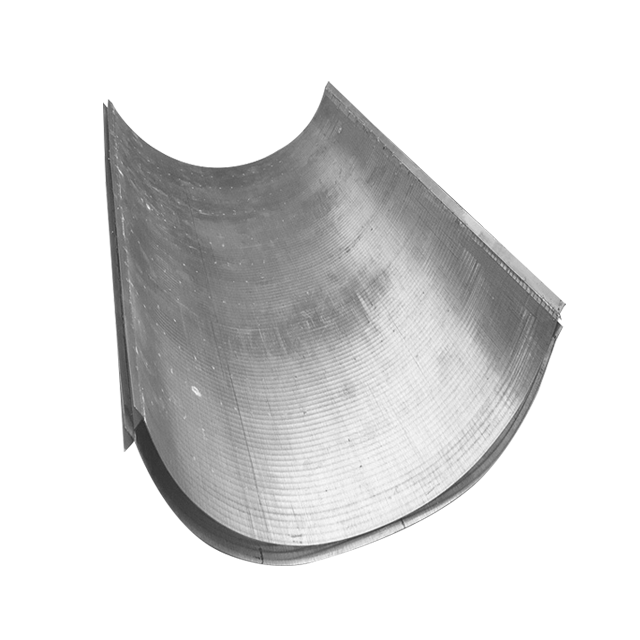
We must also evaluate aperture shape dynamics. Comparing continuous V-shaped wire profiles against standard round holes reveals significant performance differences. A Wedge Wire Screen utilizes a unique geometry. The V-shape widens inwardly. When particles enter the slot, they either pass through completely or bounce off the surface. They rarely wedge themselves tight. Traditional perforated holes trap irregular particles easily. The inward widening creates a self-cleaning mechanism.
Comparison Chart: V-Shaped Slots vs. Perforated Holes
Feature
V-Shaped Slot Profile
Standard Perforated Hole
Clogging Resistance
High (Self-cleaning geometry)
Low (Prone to particle wedging)
Contact Points
Two-point contact at the surface
Continuous wall contact
Flow Efficiency
Excellent (Inward widening reduces friction)
Moderate (Constant diameter restricts flow)
Structural Strength
High (Welded intersections)
Variable (Dependent on sheet thickness)
Conversely, the risk of oversizing presents distinct dangers. If you specify slots too large, media pass-through occurs. Sand, gravel, or industrial debris bypasses the barrier. This debris wreaks havoc on downstream equipment. Pump impeller abrasion happens quickly. Valves fail to seat properly. Furthermore, compromised effluent quality puts your facility at risk of regulatory fines. Oversizing attempts to maximize flow but ultimately destroys system integrity.
Core Evaluation Metrics for Sizing Your Screen
Accurate sizing demands rigorous analytical methods. Particle Size Distribution (PSD) analysis forms the foundation of any reliable specification. We do not rely on a single average particle size. Instead, we use a distribution curve to identify retention thresholds.
Identify the D50 Metric: This represents the median particle diameter. Half the particles are larger, and half are smaller.
Establish the D90 Metric: This indicates the size where 90% of the sample particles are smaller.
Set the Baseline: Engineers typically map the slot size closer to the D50 or D80 mark depending on whether the priority is flow volume or absolute filtration.
Calculating the open area percentage directly informs your flow velocity modeling. The mathematical formula relies on two variables: wire width and slot size. The standard equation is simple yet critical. You divide the slot size by the sum of the slot size and the wire width, then multiply by 100. If you have a 1mm slot and a 2mm wire, your open area is roughly 33%. This percentage dictates how fast fluid must travel to meet your volumetric requirements. High velocity increases friction and accelerates erosion.
Water well and groundwater applications demand careful filter pack matching. You cannot size the screen in isolation from the surrounding geology. The screen slot must hold back the artificial filter pack (the gravel envelope), not the natural aquifer sand. Best practices dictate sizing the slot to retain 90% to 100% of the filter pack material. If you miscalculate this relationship, you invite sand pumping. Sand pumping destroys submersible pumps and collapses boreholes.
Dynamic viscosity dramatically alters theoretical calculations. Real-world fluid characteristics require model adjustments. Heavy industrial sludge behaves very differently than clean, treated groundwater. Viscous fluids create higher friction against the wire profile. When dealing with thick slurries, you might need slightly wider slots or a specialized wire profile to maintain acceptable flow rates without causing extreme pressure drops.
Environmental and Compliance Factors Impacting Slot Selection
Static engineering calculations often fail when exposed to real-world environments. You must consider external variables governing your site. Regulatory discharge standards frequently dictate your absolute maximum slot size. Municipal wastewater facilities must adhere to strict guidelines. Organizations like the American Water Works Association (AWWA) publish standard compliance thresholds. Mapping your slot size capabilities to these legal requirements prevents costly facility retrofits down the line.
Thermal and chemical operating states alter material properties continuously. You cannot assume a 0.5mm slot remains 0.5mm at 200 degrees Celsius. Metals expand. High temperatures cause thermal expansion, subtly shrinking the open aperture. Corrosive chemical environments present another hazard. Harsh acids or alkaline fluids slowly degrade the wire surface.
Common Mistakes in Harsh Environments
Ignoring thermal expansion coefficients when specifying micro-slots.
Selecting standard 304 stainless steel in high-chloride fluids, leading to pitting and widened slots.
Failing to account for mechanical load changes under extreme temperature fluctuations.
Cleaning and backwashing efficiency directly links to your chosen slot size. Backwashing reverses fluid flow to dislodge accumulated debris. The aperture width determines the necessary reverse pressure. Narrower slots require significantly higher backwash pressure to clear effectively. If your pumps cannot generate adequate reverse head, the screen remains blinded. This failure increases operational downtime and labor costs.
Customizing Dimensions for Peak Performance and Scalability
Structural integrity requires a delicate balance between the wedge wire profile and the chosen aperture. You cannot separate wire depth from slot width. Deep, thick wires withstand massive pressure differentials. However, thicker wires consume more surface area, reducing the total open percentage. Engineers must optimize the profile width-to-depth ratio. High-pressure environments demand robust profiles, even if it means sacrificing a small fraction of open area.
Manufacturing tolerances define the reality of precision. Specifying a 50-micron slot on paper achieves nothing if the fabrication facility lacks capability. Sub-standard welding techniques introduce warping. Heat distortion during manufacturing causes slots to narrow or widen unpredictably across the screen surface. High-quality fabrication relies on automated, precision-controlled resistance welding to maintain exact spacing along the entire cylinder.
Scalability introduces unique specification risks. Facility upgrades rarely happen in isolation. When executing a whosale Wedge Wire Screen order across multiple geographic sites, standardization becomes paramount. Site A might have slightly different fluid dynamics than Site B. You must develop a standardized specification framework accommodating slight regional variations. Doing so ensures consistent operational reliability. It allows maintenance teams to stock universal replacement parts, simplifying long-term facility management.
Vendor Evaluation: Shortlisting a Reliable Wedge Wire Screen Manufacturer
A brilliant technical specification falls apart in the hands of an inadequate fabricator. You must evaluate potential partners rigorously. Prioritize vendors offering robust engineering and modeling support. Do not settle for companies merely selling out of a catalog. Top-tier manufacturers utilize computational fluid dynamics (CFD) to model your specific flow data. They provide custom prototyping and empirical testing before moving to full-scale production.
Quality assurance and documentation prove a vendor's legitimacy. Transparent material certifications matter. Require ISO and ASME compliance documentation upfront. Demand verifiable slot tolerance reports generated via optical measurement tools. If a vendor cannot prove their slots meet your specified micron range, you cannot trust the final product.
Vendor Assessment Criteria
Evaluation Category
Minimum Requirement
Industry Best Practice
Engineering Support
Basic CAD drawings
CFD modeling and fluid dynamics consultation
Quality Assurance
Basic material certificates
ISO certification and optical slot tolerance reports
Production Capacity
Standard sizing availability
Custom scalable runs without tolerance loss
Post-Sale Support
Standard warranty
Defined SLAs and field troubleshooting support
Assess production capacity and lead times carefully. A facility might produce a perfect prototype but fail during mass production. Ensure their automated welding lines handle large-scale custom configurations without compromising mechanical tolerances. Finally, evaluate their Service Level Agreements (SLAs). A premier wedge wire screen manufacturer excels at both pre-sale consultation and post-installation technical support. Their responsiveness defines their long-term value to your operations.
Conclusion
Upfront precision in specifying filtration dimensions fundamentally alters system lifecycle performance. Accurately matching your screen to fluid dynamics drastically reduces long-term maintenance burdens and wasteful energy consumption. Engineering a perfect balance between capture rates and pressure drops ensures your infrastructure survives harsh industrial demands.
The best technical specifications never occur in a vacuum. They require active collaboration between site engineers and a dedicated manufacturing partner. Leverage expert modeling and strict quality assurance to build resilient systems. We encourage you to request a comprehensive technical consultation today. Submit your specific flow data for accurate performance modeling, or request material prototypes to validate your design assumptions immediately.
FAQ
Q: What is the standard manufacturing tolerance for wedge wire slot sizes?
A: Standard tolerances typically range from ±0.05mm to ±0.15mm, depending on the wire profile and the precision of the resistance welding technology. Micro-slot applications demand high-precision fabrication lines to maintain exact micron variations across the entire screen surface.
Q: How do I calculate the required open area for my specific flow rate?
A: Use the standard formula: Open Area % = [Slot Size / (Slot Size + Wire Width)] x 100. Remember, actual throughput velocity depends on this percentage, plus fluid viscosity and system pressure.
Q: Can I change the slot size on an existing system to improve filtration?
A: Retrofitting is sometimes possible, but modifying slot size alters system pressure curves. Tighter slots increase head loss, potentially overwhelming existing pumps. Significant dimensional changes usually require complete screen replacement.
Q: Why do V-shaped slots resist clogging better than other screen types?
A: The V-wire profile utilizes a two-point contact physics model. Particles either pass completely through the inwardly widening gap or are swept away by fluid velocity. They cannot wedge deeply into the aperture.
We are a factory specializing in the production of high-quality wedge wire screens. We are capable of fulfilling orders of various sizes for wedge screens.