WhatsApp: +8613315867171 Email: starlee@feiyaguoji.com

- All
- Product Name
- Product Keyword
- Product Model
- Product Summary
- Product Description
- Multi Field Search

Views: 0 Author: Site Editor Publish Time: 2026-07-03 Origin: Site


Water treatment and liquid filtration are critical processes in modern industrial applications, requiring robust, reliable, and highly efficient equipment to ensure optimal outcomes. At the heart of many advanced filtration systems is the wedge wire screen tube, a highly specialized component designed to separate solids from liquids with exceptional precision. Manufactured by Anping County Xinlu Wire Mesh Products Co., Ltd., these components, also widely known as well screen tubes or strainer pipes, represent a significant leap forward in filtration technology. By leveraging a unique structural design and a wide array of premium materials, these tubes address the persistent challenges of clogging, corrosion, and flow restriction that frequently plague traditional filtration media. Whether deployed in municipal water supply systems, deep groundwater extraction wells, or complex petrochemical refining operations, selecting the right filtration equipment is paramount for operational efficiency, equipment longevity, and environmental compliance. This comprehensive guide explores the engineering principles, material specifications, diverse applications, and maintenance protocols associated with these advanced strainer pipes, illustrating precisely why they have become an indispensable asset across multiple demanding global industries.
The fundamental architecture of these filtration components is what truly sets them apart from conventional wire mesh or standard perforated pipe filters. The defining characteristic is the V-shaped profile of the wire. This specific geometric design is engineered to prevent clogging and ensure a consistently smooth water flow throughout the lifespan of the filter. When fluid passes through the screen, the V-shaped profile creates a widening gap on the interior of the tube. This means that if a particle is small enough to pass through the initial surface slot, it will continue to pass completely through the screen without becoming wedged in the opening. This self-cleaning action is crucial for maintaining flow rates and reducing the mechanical strain on pumps and associated equipment. Furthermore, the screens are designed with highly precise small openings specifically tailored to prevent sand, gravel, and other abrasive particles from entering the system. By keeping these destructive elements out, the screens protect downstream valves, pumps, and delicate processing machinery from premature wear and catastrophic failure.
The V-shaped profile is not merely a manufacturing convenience; it is a calculated hydrodynamic feature. In traditional square or round mesh filters, particles that are roughly the same size as the opening can easily become trapped, leading to rapid blinding of the screen. Once a screen is blinded, the pressure differential across the filter increases dramatically, forcing pumps to work harder and consume more energy while delivering less output. The V-shaped wire, conversely, offers only two points of contact for any given particle at the surface. If the particle pushes past these two points, the expanding nature of the V-shape ensures it is flushed away by the fluid velocity. This mechanism is particularly vital when utilizing a wedge wire screen tube for water treatment, where the continuous, uninterrupted processing of large volumes of fluid is an absolute necessity. The smooth surface also minimizes friction, contributing to the overall energy efficiency of the pumping system.
The operational environment for filtration equipment can range from relatively benign municipal water to highly aggressive, corrosive, and high-temperature chemical processes. To accommodate this vast spectrum of conditions, these strainer pipes are manufactured from an extensive array of metallic alloys. The selection of the appropriate material is the most critical factor in ensuring the longevity and reliability of the installation. The available materials include standard Low Carbon steel grades such as Q195 and Q235, which are often suitable for less corrosive environments or temporary installations where cost-effectiveness is the primary driver. However, the majority of industrial applications demand the superior performance of stainless steel and advanced alloys.
The stainless steel options are exhaustive, covering a wide range of metallurgical properties. Available grades include 201, 205, and 321, alongside the industry-standard 304 and 304L. For environments with higher chloride concentrations or more aggressive chemicals, grades 316 and 316L are provided, offering enhanced resistance to pitting and crevice corrosion. Additionally, non-magnetic variations such as 201, 205, and 205B are available for specialized applications where magnetic interference must be strictly avoided. For the most extreme environments, the material offerings extend into high-performance alloys. Duplex stainless steels, specifically grades 2205 and 2207, provide an exceptional combination of high strength and superior stress-corrosion cracking resistance. Hastelloy alloys, specifically Hastelloy C, are available for unparalleled resistance to severe chemical attacks, while Titanium alloy options offer the ultimate in strength-to-weight ratio and corrosion immunity in specific aggressive media. Furthermore, these products include anti-corrosion treatments designed to actively resist rust and encrustation, thereby significantly extending the product life even in challenging conditions.
Filtration systems are rarely one-size-fits-all, and the physical dimensions of the screen must be precisely matched to the hydraulic requirements of the specific application. The specification data provided serves as a comprehensive reference, highlighting the immense flexibility of the manufacturing process. These specifications can be extensively customized based on exact project requirements. The slot sizes, which dictate the filtration rating, can be manufactured in a range from as fine as 0.002 inches up to 0.20 inches, which corresponds to a metric range of 0.25mm to 2mm. This allows engineers to target specific particle sizes with extreme accuracy. It is worth noting that while some specifications, such as slot sizes, may be listed in multiple formats or ranges across different technical documents, the overarching capability covers this broad spectrum.
The overall physical size of the tubes is equally adaptable. Diameters are available ranging from a compact 1 inch up to a massive 20 inches (29mm to 1000mm), accommodating everything from small-scale laboratory pilot plants to massive municipal intake structures. The lengths of the tubes are also highly configurable. Standard available lengths include 2.9 meters, 5.85 meters, and typically 6.05 meters, which align with standard shipping and handling logistics. For deep well applications or large-scale continuous processes, the maximum length can extend up to 20 feet. Despite these potentially large dimensions, the inherent lightweight design of the screen facilitates significantly easier installation compared to heavier, traditional materials like slotted casing or solid pipe, reducing heavy lifting requirements and overall installation time.
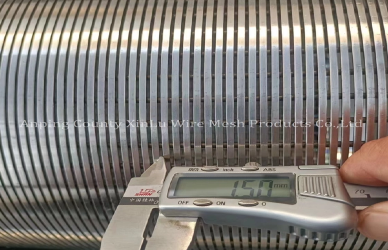
The structural integrity of the screen is derived from the precise welding of the wrapped profile wire to the internal support rods. The dimensions of these individual components are carefully selected to balance the required open area with the necessary mechanical strength to withstand collapse pressures and tensile loads. The wrapped profile wire widths are available in several configurations, including 1.52x2.54mm, 2.29x3.56mm, 3.00x4.62mm, and 3.20x6.05mm. Correspondingly, the wrapped profile wire heights range from 1.00x2.00mm to 3.50x5.00mm. This variety allows for the optimization of the V-shape geometry based on the specific fluid dynamics of the application.
The internal support structure is equally robust. The support round rods range in diameter from 2.3mm to 6.0mm, providing a rigid backbone for the screen. Alternatively, support wedge wires can be utilized, ranging from 1.8x2.5mm to 4.0x6.0mm. The combination of these specific wire and rod dimensions directly influences the percentage of open area on the screen's surface. Depending on the chosen dimensions, the percentage of open area ranges from above 11% to above 25%. A higher open area translates to lower entrance velocity for the fluid, which minimizes pressure drop, reduces the potential for localized scaling or encrustation, and maximizes the overall efficiency of the well or filtration vessel.
Integrating the screen into a larger piping system or well casing requires secure, leak-proof, and mechanically sound connections. A variety of connection methods are available to ensure seamless compatibility with existing infrastructure. One common method is the use of circumferentially welded beveled rings, which allow for strong, permanent field welds. For threaded applications, the screens are compatible with API STC BSP threads, available for both male and female connections. This ensures that the screens can be easily threaded onto standard oilfield or water well casing strings without the need for specialized adapters.
Flange connections are also available for industrial piping systems where easy removal and maintenance are required. Additionally, specialized Baffle Ring Connections can be integrated. These Baffle Ring Connections feature joints fitted with bevel plain ends, which are usually 8mm thick to provide substantial structural rigidity. These baffle rings can be manufactured with heights of 30mm, 50mm, or 100mm, depending on the specific flow control or structural requirements of the installation. This level of connection versatility is essential when designing a custom water treatment screen solution that must interface flawlessly with complex, pre-existing industrial plumbing.
The unique combination of precise filtration, robust construction, and material versatility makes these screens suitable for a vast array of industrial applications. While they are fundamentally designed for liquid/solid separation, the specific contexts in which they are deployed vary wildly. In the realm of municipal and industrial infrastructure, they are heavily utilized for general water treatment and well pumping. Their ability to handle high flow rates while excluding fine particulates makes them ideal for sand filtration in water supply systems, ensuring that drinking water or process water meets stringent quality standards.
Beyond basic water supply, these screens are critical components in groundwater extraction and control systems. Whether for agricultural irrigation, dewatering construction sites, or managing aquifer levels, the screens provide reliable, long-term performance deep underground. In the construction and architecture sectors, they are employed for sophisticated water management tasks, where both functionality and, occasionally, aesthetic considerations in visible drainage systems are important. The lightweight nature of the screens is particularly beneficial in these scenarios, allowing for rapid deployment and integration into complex architectural designs.
The refining and petrochemical industries present some of the most demanding environments for any mechanical equipment. High temperatures, corrosive fluids, and high pressures are standard operating conditions. The availability of high-grade stainless steels, Duplex alloys, and Hastelloy makes these screens perfectly suited for these rigorous applications. They are frequently used as catalyst bed supports, in media retention vessels, and within various separation columns where precise fluid dynamics and absolute material reliability are non-negotiable.
Similarly, the mineral and aggregate processing industries rely on these robust screens for dewatering, sizing, and washing operations. The heavy-duty profile wires and support rods can withstand the constant abrasion of crushed rock, coal, and mineral slurries. In the pulp and paper industry, the screens are integrated into production processes for fiber recovery, water recycling, and the filtration of various chemical liquors. The smooth surface of the V-wire is particularly adept at preventing the build-up of fibrous materials that would quickly blind other types of filters.
These screens are frequently incorporated as the core functional element within larger, more complex filtration machinery. For example, they are commonly used as the primary media in drum filters and pump filters. In a drum filter configuration, the screen is formed into a cylinder that rotates through the fluid, continuously separating solids while a backwash mechanism cleans the exposed surface. When used as a wedge wire filter cartridge for liquid filtration, the screen provides a highly durable, cleanable alternative to disposable paper or synthetic cartridges, significantly reducing long-term operational costs and environmental waste.
The pharmaceutical and food processing industries also benefit immensely from this technology. The sanitary requirements of these industries demand materials that are not only corrosion-resistant but also easy to clean and sterilize. The smooth, non-porous surface of stainless steel wedge wire, combined with its resistance to high-temperature cleaning protocols, makes it an ideal choice for filtering everything from active pharmaceutical ingredients to beverages and liquid food products. Furthermore, in waste water treatment facilities, these screens are essential for preliminary solid removal, sludge dewatering, and effluent polishing, helping facilities meet strict environmental discharge regulations. Even in highly specialized fields like the salt industry, the screens are utilized in filtration processes to separate crystallized salt from brine, demonstrating their incredible versatility across the industrial spectrum.
The total cost of ownership for filtration equipment is heavily influenced by the ease of installation and the ongoing maintenance requirements. As previously noted, the lightweight design of these screens facilitates easier installation compared to heavier materials, reducing labor costs and the need for heavy lifting equipment on site. The compatibility with standard API STC BSP threads and various flange options further streamlines the integration process, allowing for rapid deployment in both new constructions and retrofitting projects.
Once installed, the maintenance protocols are remarkably straightforward. The inherent self-cleaning nature of the V-shaped profile significantly extends the operational time between cleaning cycles. When cleaning is eventually required, maintenance can typically be performed via simple backwashing. By reversing the flow of clean fluid through the screen, any trapped particles are easily dislodged and flushed out of the system, restoring the screen to its original operational efficiency without the need for manual scrubbing or harsh chemical treatments. This simple backwashing capability, combined with the robust anti-corrosion treatments that resist rust and encrustation, ensures a long, productive lifespan for the equipment, minimizing downtime and maximizing the return on investment for the facility operator.
The Wedge Wire Screen Tube, manufactured by Anping County Xinlu Wire Mesh Products Co., Ltd., offers exceptional practical value for industries requiring reliable, high-efficiency liquid filtration and solid separation. By combining a clog-resistant V-shaped profile with a vast selection of premium, corrosion-resistant materials—from standard stainless steels to advanced Duplex and Titanium alloys—these customizable strainer pipes ensure smooth water flow and protect critical downstream equipment from abrasive damage. With highly configurable slot sizes, dimensions, and versatile connection methods like API STC BSP threads and baffle rings, they are perfectly suited for a diverse audience of engineers and facility managers operating in water treatment, petrochemical refining, food processing, and groundwater extraction, providing a lightweight, easily maintainable solution that significantly extends operational longevity through simple backwashing protocols.


