Inefficient solid-liquid separation directly impacts plant profitability through high wear rates, frequent blinding, and unplanned downtime during high-volume processing. Engineers and plant managers constantly face the challenge of balancing maximum flow capacity with precise particle retention. Off-the-shelf flat screens often fail under specific gravitational and abrasive loads, leading to compromised end-product quality and excessive maintenance interventions. To solve this, facilities require a robust, high-capacity static solution engineered for continuous operation.
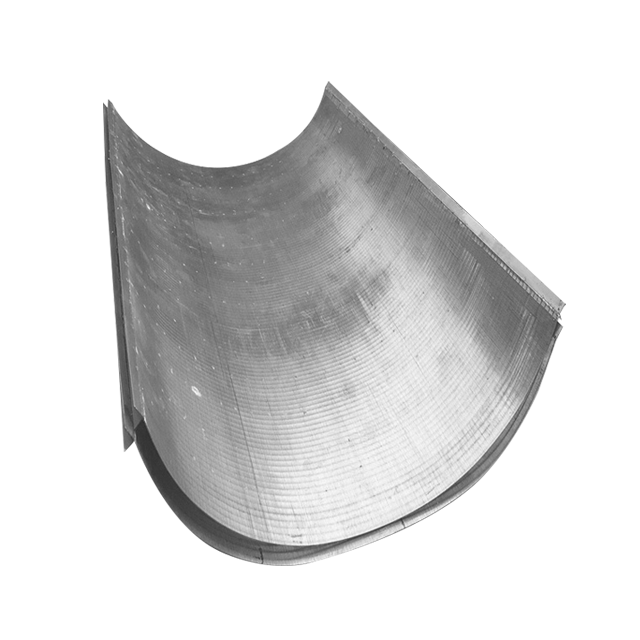
The Sieve Bend Screen, historically known as the DSM (Dutch State Mines) screen, leverages gravitational forces and specific curved surface geometry to consistently outperform traditional flat screens. By utilizing precise wedge wire profiles along a calculated arc, this equipment shears liquid away from solid particles rapidly and efficiently. Understanding how to evaluate and specify custom configurations for these screens optimizes plant throughput and minimizes operational disruptions.
- Optimal sieve bend screen selection requires matching the slot aperture and arc length to the specific flow rate and particle size distribution of the feed.
- Material selection (e.g., 304/316L Stainless Steel vs. Duplex) dictates the lifespan of the wedge wire screen panel under corrosive or highly abrasive conditions.
- Curved static screens offer higher dewatering capacity than flat screens due to centrifugal and gravitational forces, but require precise installation angles to prevent premature wear.
- Long-term operational success is driven less by initial capital expenditure and more by the screen's resistance to blinding, ease of maintenance, and custom housing adaptability.
Core Mechanics: Why the Curved Geometry Matters in an Industrial Screening System
The fundamental advantage of a curved screening surface lies in fluid dynamics. When slurry enters the top of the screen, gravitational and centrifugal forces accelerate the feed material downward along the concave surface. This acceleration thins the slurry bed significantly. As the material travels across the horizontal wedge wires, the curved geometry forces the liquid phase to change direction. It drives the liquid through the slots while retaining the solid particles on the surface. This continuous shearing action prevents the formation of a thick fluid boundary layer. It drastically increases the dewatering rate compared to standard flat vibrating screens.
This separation mechanism relies heavily on the Coanda effect. As the liquid flows over the profile wire, it naturally adheres to the curved and angled surface of the wire itself. This physical phenomenon effectively pulls the fluid down through the aperture. It strips moisture away from the descending solids. The precise angle of the wedge wire slices into the fluid stream. It ensures that even high-viscosity liquids separate efficiently from the solid matrix without requiring external pressure.
Transitioning from dynamic to static solid liquid separation equipment yields substantial operational expenditure benefits. Static curved screens operate with zero moving parts. They eliminate the need for drive motors, gearboxes, and complex lubrication systems. This absence of mechanical motion translates to lower energy consumption. It also eliminates structural vibration that can fatigue surrounding infrastructure. Facilities benefit from continuous, gravity-fed operation that requires minimal operator intervention while maintaining high volumetric throughput.
Field data shows that static screens handle surge loads much better than vibrating alternatives. When a sudden influx of slurry hits a vibrating screen, the bed depth increases, often leading to fluid carry-over. A curved screen simply accelerates the larger volume across its surface. The centrifugal force increases proportionally with the fluid velocity, maintaining the shearing efficiency even during unexpected flow spikes.
Critical Evaluation Dimensions for Sieve Bend Screen Selection
1. Slot Size (Aperture) and Profile Wire Geometry
Selecting the correct slot size is the most critical step in configuring an industrial screening system. The slot width directly dictates the particle cut size. As a general engineering rule, the effective cut size of a curved screen is approximately half the actual slot width. For example, a 1.0 mm slot typically retains particles larger than 0.5 mm. This occurs because the fluid trajectory and the angle of approach cause particles to bridge the gap rather than fall directly through it. Accurate particle size distribution analysis of the feed is mandatory. You must specify an aperture that maximizes liquid recovery without passing unacceptable levels of solids.
The relief angle of the wedge wire profile is equally important. Manufacturers produce wedge wire with a V-shaped profile that widens inward. This creates a two-point contact surface for particles. If a particle is slightly smaller than the slot width, it passes through immediately. If it is larger, it remains on the surface. Because the slot widens beneath the surface, particles cannot easily wedge themselves into the aperture. This self-cleaning geometry prevents blinding and pegging. It ensures consistent flow rates over extended production cycles.
Engineers must balance impact load capacity with open area requirements when selecting the wire profile. Thicker, heavier wire profiles withstand high-velocity impact and heavy abrasive loads. However, they result in a lower overall open area percentage, which slightly reduces hydraulic capacity. Conversely, thinner wire profiles maximize open area and flow rates but may deform under heavy physical stress. The selection framework must weigh the specific gravity of the solids against the required volumetric liquid throughput.
2. Arc Length, Radius, Width Sizing, and Custom Housings
Proper screen sizing prevents overflow and ensures optimal moisture reduction. You calculate the required screen width based on the maximum anticipated volumetric flow rate and the viscosity of the fluid. A wider screen distributes the feed more thinly across the surface. This enhances the shearing action and prevents the slurry from overwhelming the slots. Narrow screens forced to handle high volumes experience fluid bypass, where liquid carries over the discharge lip along with the solids.
The arc length and radius determine the retention time of the material on the screen deck. Standard arc lengths are typically 45°, 60°, or 120°. A 45° or 60° arc is generally sufficient for standard dewatering and sizing applications. It provides a quick, efficient separation. A 120° arc offers extended retention time. It allows for maximum moisture removal before the solids discharge. The radius of the curve must match the trajectory of the feed to maintain consistent centrifugal force throughout the material's descent.
Scalability and pipeline integration require careful consideration of custom housings. Modular screen panels allow facilities to expand capacity by adding parallel units without completely re-engineering the primary feed lines. Custom flanging, adjustable feed weirs, and enclosed housings ensure seamless integration into existing infrastructure. Enclosed housings are particularly vital for controlling odors, containing splash, and managing hazardous vapors in chemical or municipal applications.
When designing the housing, you must also account for the feed box design. A poorly designed feed box creates turbulent flow, which disrupts the even distribution of slurry across the screen width. We recommend incorporating a velocity-reducing baffle inside the feed box. This ensures the slurry overflows the weir in a smooth, laminar sheet, maximizing the efficiency of the top section of the screen.
Material Grade and Wear Resistance
The metallurgical composition of the screen dictates its operational lifespan. Standard 304 stainless steel is suitable for general dewatering applications where the fluid is non-corrosive and the solids are relatively soft. For environments involving mild chlorides, organic acids, or strict sanitary requirements, 316L stainless steel is the baseline standard. The addition of molybdenum in 316L provides superior pitting resistance. This makes it ideal for food processing and municipal waste applications.
When deploying mining screening equipment, standard stainless steels often degrade rapidly under severe abrasive wear. In these scenarios, Duplex stainless steel (such as 2205) offers a much higher yield strength and exceptional resistance to stress corrosion cracking. For extreme abrasion, polyurethane-coated wedge wire or hardened high-carbon alloys extend the replacement cycle. The selection process must analyze the trade-off between higher upfront material costs and the long-term savings realized through reduced maintenance frequency.
Material Grade Comparison for Sieve Bend Screens | Material Grade | Primary Characteristics | Ideal Applications | Relative Wear Resistance |
| 304 Stainless Steel | Good general corrosion resistance, economical. | General water filtration, non-abrasive solids. | Moderate |
| 316L Stainless Steel | High pitting resistance, sanitary finish capable. | Food & Beverage, Pulp & Paper, mild chemicals. | High |
| Duplex (2205) | High yield strength, excellent chloride resistance. | Mining, heavy mineral processing, high-stress loads. | Very High |
| Polyurethane Coated | Impact absorbing, extreme abrasion resistance. | Heavy aggregates, dense media recovery. | Maximum |
Application-Specific Configurations and Success Criteria
Wastewater Filtration Screen Deployment
In municipal and industrial effluent treatment, the primary success criterion is maximum BOD/COD reduction through efficient primary solid removal. A properly configured wastewater filtration screen must resist biological fouling and handle highly variable flow rates during storm events. Configuration focus should center on finer slot sizes (typically 0.25 mm to 1.0 mm) to capture fine organic matter. Compatibility with automated high-pressure backwash systems is essential to clear grease and biological buildup. Corrosion-resistant alloys like 316L are mandatory to withstand hydrogen sulfide and other aggressive compounds present in raw sewage.
Operators should also consider the integration of automated spray bars. In wastewater applications, fats, oils, and grease (FOG) can quickly coat the wedge wire, reducing the open area. A timed, high-pressure hot water spray system keeps the slots clear without requiring manual scrubbing, ensuring continuous operation even during peak flow periods.
Mining and Mineral Processing
Mineral processing demands high impact resistance and the ability to handle heavy, dense slurry concentrations. The success criteria revolve around precise classification for dense media recovery and continuous operation under extreme abrasive wear. Configurations require thicker wedge wire profiles to absorb the kinetic energy of falling rocks and heavy ores. Steep installation angles accelerate the heavy slurry, preventing the material from stalling on the screen deck. Abrasion-resistant housings and reversible screen panels are critical to extending the operational life of the equipment in these harsh environments.
In coal preparation plants, sieve bends are heavily utilized for desliming and magnetite recovery. The specific gravity of the media requires a screen that can handle high volumetric loads without flexing. We often specify cross-support rods welded at closer intervals to provide the necessary structural rigidity under these heavy loads.
Pulp and Paper Processing
The pulp and paper industry relies on curved screens for efficient fiber recovery, wash water clarification, and reliable black liquor screening. The primary challenge is preventing the long, fibrous materials from stapling over the wire profiles and plugging the screen. Success requires custom arc lengths optimized for specific fiber lengths and high open-area wedge wire profiles that allow rapid liquid drainage. 316L stainless steel is universally specified to resist the harsh chemical corrosion associated with bleaching agents and alkaline black liquor.
Food and Beverage Processing
Sanitary compliance is the absolute priority in food and beverage applications. Screens used for separating solids from process water, juices, or brewing mash must meet strict FDA and 3-A sanitary standards. The equipment must facilitate easy, thorough washdowns to guarantee zero cross-contamination between batches. Configurations demand electropolished finishes to eliminate microscopic surface imperfections where bacteria can harbor. Crevice-free welding and high-grade 316L stainless steel construction ensure the system can withstand aggressive CIP (Clean-In-Place) chemical regimens without degrading.
Implementation Risks and Mitigation Strategies
A primary implementation risk is the potential for blinding or pegging, which drastically reduces hydraulic capacity. This typically occurs when slot sizing is incorrectly specified for the particle size distribution, or when fluctuating feed rates cause the slurry velocity to drop, allowing particles to settle into the apertures. To mitigate this risk, engineers should implement adjustable feed weirs to ensure a consistent, uniform velocity across the entire width of the screen. In applications prone to sticky or fibrous materials, integrating pneumatic rapping systems or automated spray bars dislodges trapped particles and maintains open area.
Uneven wear patterns present a significant challenge, particularly at the feed impact zone where the slurry first contacts the screen deck. Localized wear can compromise the precise slot aperture in one section while the rest of the screen remains functional. The most effective mitigation strategy is to specify reversible screen panels. This design feature allows maintenance teams to physically remove the panel, flip it end-over-end, and reinstall it. Reversing the panel shifts the impact zone to the unworn end, effectively doubling the operational lifespan of the screen before replacement is required.
Installation angle errors directly alter the effective cut size and dewatering efficiency of the system. If the screen is mounted too steeply, material accelerates too quickly, reducing retention time and resulting in wet discharge. If the angle is too shallow, material stalls, causing buildup and eventual overflow. To mitigate installation errors, specify adjustable pivot housings. These specialized enclosures allow operators to fine-tune the mounting angle during the commissioning phase, adjusting the gravitational pull to match the exact behavior of the live slurry.
Another risk involves improper feed presentation. If the slurry enters the screen with too much turbulence, it will not spread evenly. This causes channeling, where high-velocity streams wear out specific sections of the wire prematurely while other sections remain underutilized. Installing a proper header box with internal baffles calms the flow, ensuring a uniform sheet of slurry hits the screen deck.
Conclusion
- Compile comprehensive feed analysis data, including maximum volumetric flow rate, solids concentration, particle size distribution, and fluid pH.
- Evaluate your current maintenance cycles to determine if upgrading to a more abrasion-resistant alloy or a reversible panel design will reduce downtime.
- Consult with a specialized solid-liquid separation engineer to develop a technical proposal based on your specific spatial constraints and integration requirements.
- Request computational fluid dynamics (CFD) modeling from your vendor to validate flow rates and separation efficiency before full-scale fabrication.
FAQ
Q: What is a DSM screen, and is it different from a sieve bend screen?
A: DSM stands for Dutch State Mines, the organization that originally invented and patented the curved screen profile for coal processing. There is no functional difference; the terms DSM screen and sieve bend screen are used interchangeably throughout the industrial separation industry to describe the same static, curved wedge wire equipment.
Q: What is the standard slot size range for a sieve bend screen?
A: Slot sizes typically range from as fine as 50 microns (0.05 mm) for delicate starch or fine chemical separation, up to several millimeters for heavy aggregate and mining applications. The specific aperture is chosen based on the required particle cut size and the viscosity of the carrying fluid.
Q: How does a sieve bend screen compare to a rotary drum screen?
A: A sieve bend is a static, gravity-fed device with no moving parts, resulting in minimal maintenance and zero energy consumption. A rotary drum screen is motorized, dynamic equipment. While drum screens handle sticky materials well due to continuous rotation and scraping, sieve bends offer higher hydraulic throughput in a smaller footprint for free-draining slurries.
Q: Can wedge wire screen panels be reversed to extend their lifespan?
A: Yes, many high-quality curved screens are designed with symmetrical frames that allow the panel to be removed and flipped end-over-end. Because the heaviest wear occurs at the top impact zone, reversing the panel distributes the abrasive wear evenly, significantly extending the usable life of the equipment.
Q: What factors determine the flow capacity of an industrial screening system?
A: Flow capacity is determined by the total physical width of the screen, the percentage of open area dictated by the wire profile and slot size, the feed pressure or velocity, and the viscosity of the fluid. Wider screens and larger slot apertures naturally accommodate higher volumetric flow rates.
Q: How often do sieve bend screens need to be replaced?
A: Replacement timelines vary drastically based on the application. In non-abrasive wastewater or food processing applications, a 316L stainless steel screen can last several years. In highly abrasive mining or aggregate environments, even hardened or Duplex steel screens may require replacement or reversal every few months due to severe physical wear.


