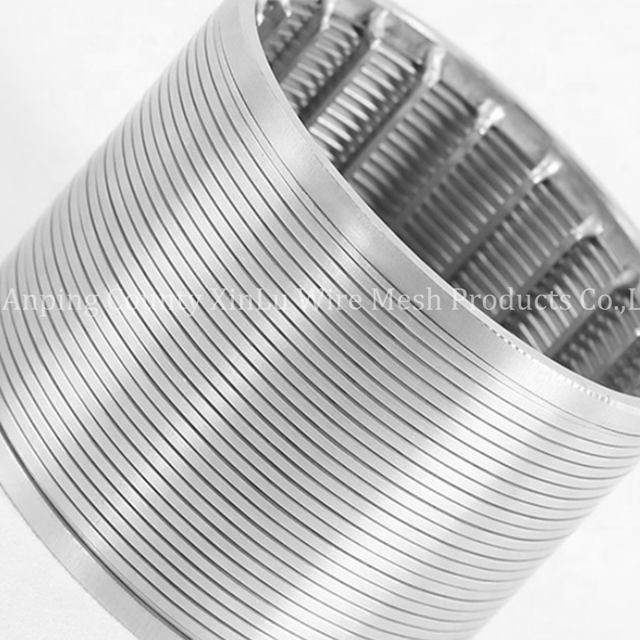
In industrial solid-liquid separation, the precise specification of a wedge wire screen dictates the operational baseline for the entire system. Specifying an incorrect screen opening size creates a cascading failure loop. Oversized slots lead to downstream contamination and equipment damage, while undersized slots cause rapid blinding, excessive pressure drops, and pump fatigue. Moving beyond basic mesh equivalents requires an engineering-led approach to specification. You cannot simply guess the dimensions based on visual inspection or outdated legacy drawings. This guide breaks down the fluid dynamics, structural trade-offs, and application-specific variables required to specify screens that balance particle retention, maximum throughput, and extended equipment lifespan. We will examine the exact mechanics of fluid flow through V-shaped profiles and how to match these geometries to your specific process conditions.
Filtration vs. Flow Trade-off: Smaller slot sizes increase filtration accuracy but exponentially reduce the open area, requiring larger screen footprints or higher operating pressures to maintain flow rates.
The Open Area Equation: System efficiency is dictated by the ratio of slot size to profile wire width; maximizing open area without compromising structural integrity is the primary engineering challenge.
Profile Geometry Matters: The continuous V-shaped slot design inherently resists clogging, but its effectiveness relies entirely on matching the slot width to the specific particle size distribution (D50/D90) of the process fluid.
Flow Direction Dictates Design: Whether utilizing a wedge wire screen tube or a flat panel, the direction of flow (Flow-Out-To-In vs. Flow-In-To-Out) fundamentally alters how slot size interacts with system pressure and backwashing cycles.
The Physics of Wedge Wire Screen Slot Size
The technical definition of a Wedge Wire Screen Slot Size refers to the exact, continuous gap between two adjacent profile wires. Engineers measure this dimension in millimeters or microns, depending on the industry standard. Bridging the gap between traditional mesh size terminology and absolute slot measurements eliminates specification errors in demanding applications. A continuous slot screen differs from woven wire mesh or perforated plates because it relies on two-point particle contact rather than multi-point entrapment. Traditional mesh traps irregular solids within its woven intersections. Wedge wire utilizes two parallel surfaces, minimizing contact points and allowing near-size particles to pass freely through the opening.
The primary advantage of this technology lies in the V-wire profile geometry. Immediately beneath the screen surface, the gap widens continuously. This specific wedge shape prevents particle wedging and surface blinding. Solids either remain on the surface or pass completely through the expanding channel. This self-cleaning characteristic provides superior separation efficiency compared to straight-punched holes. When fluid hits the flat top of the profile wire, it shears across the surface, directing the liquid through the slot while pushing the oversized solids along the screen face.
Aspect ratios govern the relationship between wire width, wire depth, and the resulting slot size. Higher aspect ratios feature deeper, narrower wires. These profiles allow for narrower slots and better separation efficiency. However, they introduce structural vulnerabilities. Deep, thin wires can deflect under high differential pressures, compromising the precise gap tolerance. You must balance the need for a fine slot with the mechanical strength required to withstand the process pressure.
To understand the physical dimensions, consider the standard profile wire shapes used in heavy industry. A standard triangle profile might have a width of 1.5mm and a depth of 2.5mm. If you set the slot at 0.5mm, the total pitch (wire width plus slot) is 2.0mm. This geometry dictates the flow characteristics and the structural load capacity of the entire panel or cylinder.
How Slot Size Impacts Filtration Accuracy and Flow Rates
The core trade-off in screen design balances particle retention against volumetric throughput. Tightening the slot size directly causes a drop in flow capacity. filtration accuracy in wedge wire applications refers to absolute retention ratings rather than nominal estimates. If a slot is precisely 0.5 millimeters, rigid particles larger than 0.5 millimeters cannot pass. Capturing finer solids exponentially reduces the available flow area, forcing you to either increase the physical size of the screen or accept a higher pressure drop.
Engineers rely on a standard industry formula to calculate the open area percentage: Open Area (%) = [Slot Size / (Slot Size + Wire Width)] x 100. Consider a practical calculation example. A screen engineered with a 0.5 mm slot size and a 1.5 mm profile wire width yields exactly a 25% open area. Realistic boundaries for open area typically range from 15% to 65%. Pushing these limits by utilizing ultra-thin profile wires maximizes flow but significantly reduces mechanical strength and screen lifespan.
Slot Size (mm)
Profile Wire Width (mm)
Calculated Open Area (%)
Typical Application
0.25
1.0
20.0%
Fine chemical filtration
0.50
1.5
25.0%
Industrial water intake
1.00
2.0
33.3%
Mining slurry separation
2.00
3.0
40.0%
Heavy aggregate sizing
3.00
3.0
50.0%
High-volume storm water
Restrictive slot sizes directly increase differential pressure across the screen surface. This pressure drop forces pumps to work harder to maintain required flow rates. The secondary costs of undersized slots are substantial. Facilities face increased energy consumption, premature pump wear, and the necessity for highly frequent cleaning cycles. When the open area drops below the system's required threshold, the fluid velocity through the remaining open slots increases dramatically. This high velocity accelerates wear on the profile wires, particularly if the fluid contains abrasive sand or grit.
You must also account for the blinding factor. Even with the V-wire design, a certain percentage of the open area will be temporarily blocked by solids during normal operation. If you design a system requiring 100% of the theoretical open area to function, it will fail immediately upon startup. Always apply a safety factor to your open area calculations to accommodate normal operational blinding.
Framework for Slot Size Selection in Industrial Applications
Relying on a single maximum particle size is insufficient for proper slot size selection. Engineers must analyze the complete Particle Size Distribution (PSD) of the process fluid. Utilizing D50 (median) and D90 (90th percentile) particle size metrics determines the optimal retention threshold. You must actively prevent clogging by ensuring the selected slot size does not exactly match the median particle size of the solids. Matching the D50 size precisely guarantees rapid surface blinding, as half the particles will attempt to wedge into the slots simultaneously.
Fluid viscosity and process dynamics dictate different slot requirements. A standard water filtration screen handles low-viscosity fluids, allowing for finer slots without massive pressure drops. High-viscosity or high-solids applications, such as mining slurries or pulp processing, demand wider slots and heavier wire profiles. Operating temperatures and chemical aggressiveness also alter fluid dynamics, requiring adjustments to the initial slot specification. Hot fluids generally have lower viscosity, which might allow for a slightly tighter slot, but thermal expansion of the metal must be calculated to ensure the slot does not close up at operating temperature.
Choosing a slot size finer than the process actually requires introduces severe operational risks. Over-specifying drives up initial capital expenditure. More importantly, it inflates ongoing operational expenditure through unnecessary maintenance, frequent backwashing, and accelerated component wear. If your downstream process can handle 1mm particles, do not specify a 0.5mm slot just to be safe. That decision will cut your flow rate in half and double your pumping energy requirements.
Obtain a comprehensive laboratory analysis of the fluid's particle size distribution.
Identify the maximum allowable particle size for downstream equipment protection.
Calculate the required volumetric flow rate and maximum allowable pressure drop.
Select a profile wire that provides the necessary structural strength for the system pressure.
Determine the slot size that provides the highest open area while retaining the target particles.
Evaluating Wedge Wire Screen Tubes vs. Flat Panels
Slot size interacts differently with radial flow in a wedge wire screen tube compared to gravity-fed flat panels. Cylindrical elements used in strainers, well screens, and rotary drums process fluids radially. Calculating the total effective open area in a cylindrical geometry requires factoring in the internal or external diameter, as the available surface area changes depending on the flow direction. The geometry of a cylinder naturally provides high structural integrity against collapse pressures, allowing for slightly thinner profile wires and higher open areas compared to a flat panel spanning the same distance.
Evaluating Flow-Out-To-In (FOTI) versus Flow-In-To-Out (FITO) configurations is critical. The direction of flow dictates whether the flat face of the V-wire sits on the inside or outside of the cylinder. If you get this wrong, the wedge geometry works in reverse, trapping particles inside the widening gap and permanently destroying the screen. Furthermore, engineers must choose between axial and radial slot orientations. This orientation impacts particle shearing, liquid bypass rates, and how structural loads distribute across the support rods.
In a rotary drum application, the slot orientation is usually parallel to the axis of rotation. As the drum turns, a stationary scraper blade cleans the surface. The slot size must be carefully matched to the scraper blade thickness and material. If the slots are too wide, the blade can catch the edge of a profile wire and rip it from the support rods. If the slots are too fine, the blade will simply smear soft solids over the openings, blinding the screen entirely.
Implementation Risks: Wear, Blinding, and Maintenance
Abrasive process fluids cause profile wire wear over time. This material degradation gradually increases the effective slot size, reducing separation accuracy. Selecting appropriate alloys is critical to maintain slot tolerance over the equipment lifecycle. Standard applications use 304 or 316L Stainless Steel. Highly corrosive or abrasive environments require Duplex stainless steel or Hastelloy. As the top surface of the V-wire wears down, the gap between the wires naturally widens due to the wedge shape. You must monitor this wear and replace the screen before the widened slots allow oversized particles to damage downstream pumps.
Precise slot selection directly minimizes system maintenance intervals. It extends the overall service life of both the screen and downstream components. The slot size also dictates the required velocity and pressure for effective backwashing. A tighter slot requires higher backwash pressure to dislodge trapped particles. If your system cannot generate sufficient backwash pressure, the fine slots will permanently blind.
Combining ultra-fine slot sizes with high differential pressures creates significant structural failure risks. Without adequate support rods, the profile wires will deflect, destroying the uniform gap. Mitigation strategies involve specifying heavier support profiles or tighter support rod spacing to prevent wire deflection under heavy loads. You must calculate the maximum differential pressure the screen will experience during a fully blinded condition and design the support structure to withstand that exact load.
Failure Mode
Primary Cause
Engineering Solution
Rapid Surface Blinding
Slot size matches D50 particle size
Adjust slot size to be 20% larger or smaller than D50
Profile Wire Deflection
Excessive differential pressure
Increase support rod density or thickness
Accelerated Slot Widening
High fluid velocity with abrasives
Increase total open area to reduce velocity
Backwash Failure
Insufficient reverse flow pressure
Upgrade backwash pumps or increase slot size
Conclusion
Optimal wedge wire screen slot size is never a default selection. It represents a calculated compromise between required particle retention, necessary open area, and structural durability. You must evaluate the physical properties of your fluid, the mechanical limits of your pumping system, and the structural capacity of the screen itself.
Compile accurate data on particle size distribution (D50/D90) before finalizing any specification.
Determine the maximum acceptable pressure drop for your existing pump infrastructure.
Evaluate fluid viscosity and operating temperatures to adjust theoretical flow calculations.
Conduct physical pilot tests to validate slot size and open area calculations against real-world process conditions.
FAQ
Q: What is the minimum slot size available for wedge wire screens?
A: High-precision continuous slot screens can be engineered with slot sizes as fine as 20 microns (0.02 mm). However, 50 to 100 microns is much more common for industrial applications requiring reliable structural integrity under pressure.
Q: How do I convert mesh size to wedge wire screen opening size?
A: Mesh size refers to the number of openings per linear inch. Wedge wire slot size is an absolute measurement of the gap in microns or millimeters. You need a conversion chart. For example, a 100-mesh screen roughly equates to a 149-micron slot size.
Q: Does a larger open area always mean better filtration performance?
A: No. While a larger open area improves the flow rate and reduces pressure drop, it requires either a larger slot size or thinner profile wires. This reduces filtration accuracy or compromises the mechanical strength of the screen.
Q: Why is my water filtration screen clogging despite having a continuous slot design?
A: Clogging in V-wire screens usually indicates that the chosen slot size exactly matches the median particle size (D50) of your solids. It can also result from insufficient backwashing pressure or highly sticky contaminants adhering to the metal.
Q: Can slot sizes be customized for varying flow directions?
A: Yes. Manufacturers customize the profile wire orientation based on Flow-In-To-Out (FITO) or Flow-Out-To-In (FOTI) requirements. The flat face of the wedge wire must always face the incoming fluid to utilize the widening gap geometry effectively.
We are a factory specializing in the production of high-quality wedge wire screens. We are capable of fulfilling orders of various sizes for wedge screens.